

Keratoconus
When the centre of the cornea thins and protrudes.
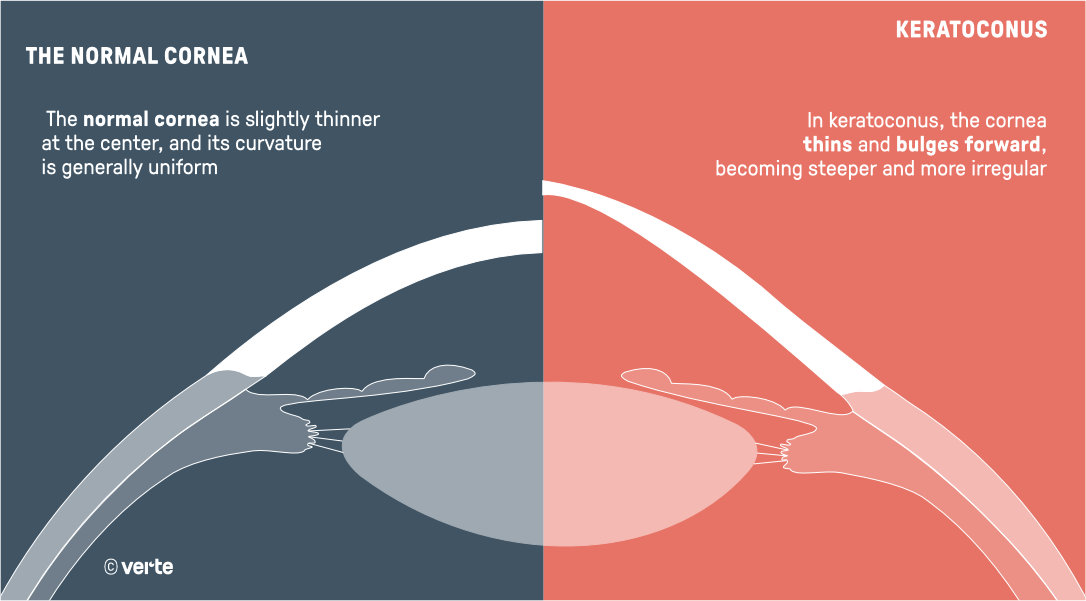
What is Keratoconus?
Keratoconus, or conical cornea, is a condition characterised by a progressive increase in corneal curvature associated with thinning of the corneal apex. As a consequence, it affects the eye's refractive error, inducing myopia and/or regular or irregular astigmatism. It follows a course of total absence of inflammation and produces a progressive reduction in vision. Keratoconus is a form of corneal ectasia.
It is the leading cause of corneal transplant in young people and presents bilaterally, although in the vast majority of cases asymmetrically (one eye affected to a different degree than the other).
Are the causes known? Are some people at greater risk?
There is a hereditary relationship, and the remaining cases appear sporadically. Scientific evidence also links it to atopic conditions, ocular allergy and continuous eye rubbing.
What symptoms does it produce?
The first symptom is a reduction in visual acuity. At this stage the cornea appears normal and the process may go unnoticed, presenting simply as a patient who needs glasses. Over time, progressive worsening of astigmatism occurs, along with glare, eye fatigue and increased sensitivity to light. In its final stage, vision may be severely reduced.
At what stage of life does it occur?
The condition normally appears at the end of the first decade of life and the beginning of the second. It will often progress slowly over 10 to 20 years, after which it tends to stabilise. It generally shows a variable degree of asymmetry between the two eyes.
How can it be treated?
Keratoconus today is a condition with many therapeutic options, reducing to a minimum the percentage of patients who ultimately require the final solution: corneal transplant. There are three approaches to consider:
- The first: correction of the refractive error induced by the altered cornea. In this regard, all available optical devices may be used to provide the patient with good visual quality: spectacles or contact lenses, particularly the latter in their rigid or semi-rigid form.
- The second: halting the progression of corneal steepening and thinning. In this line of treatment, Corneal Cross-Linking (CXL) is the main option.
- And the third: correction of the optical aberrations produced by irregular astigmatism with Intrastromal Corneal Ring Segments (ICRS).
Can it be prevented?
There is no prevention of the condition, but surgical treatments are applied to halt its progression. Early detection is important for the diagnosis of more advanced cases. It is recommended that first-degree relatives of patients with keratoconus be examined, especially in young patients or children.
Can it be serious?
In more complicated cases, the cornea may rupture at a central level in its innermost layer, allowing fluid to enter its structure (acute hydrops), producing significant visual impairment. Cases with central lesions are the only ones that are directed towards corneal transplant. Fortunately, of all corneal transplants, this is the one with the best post-surgical visual prognosis.