

Floaters
Do you see dots, veils, clouds, wavy lines or spots that seem to float in your visual field?
The sudden appearance of floaters (myodesopsia) is a very common phenomenon that can be benign… but sometimes signals a more serious problem in the retina.
What are floaters?
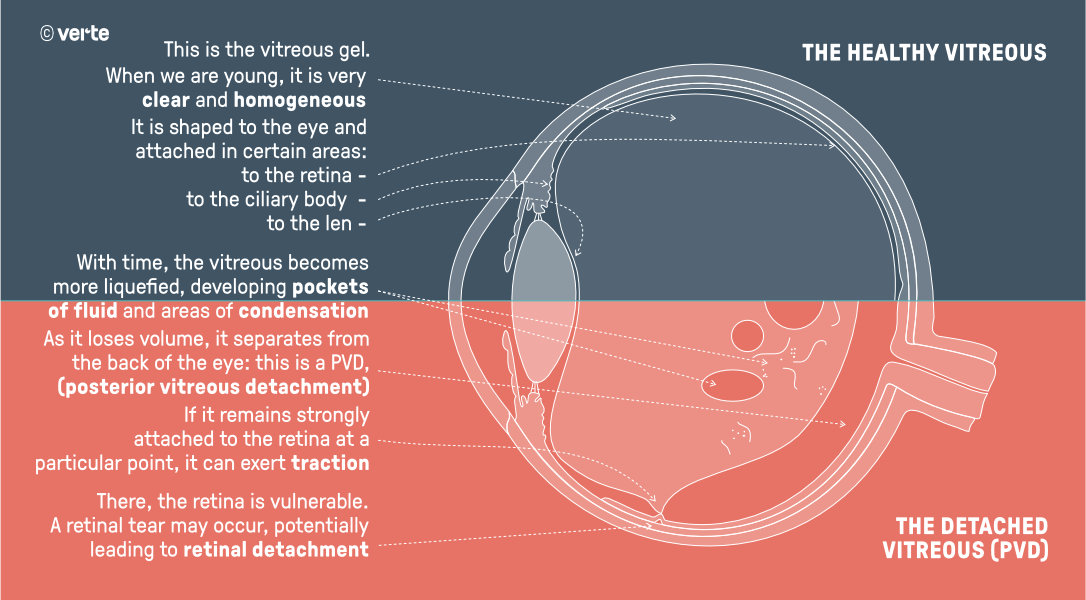
The interior of the eye is filled with a transparent gel called the vitreous, which is in close contact with the retina. Over time, this gel loses density, more liquid areas form and it eventually separates from the retina. This process is called posterior vitreous detachment (PVD).
During this separation, small opacities appear in the vitreous that cast shadows on the retina: the well-known "floaters" that move as you move your eyes.
- They are very common from a certain age onwards.
- They are more frequent in myopic individuals.
- In Spanish they are called "moscas volantes".
How does posterior vitreous detachment present?
The most common presentation is the sudden appearance of floaters. These are sometimes accompanied by flashes of light (photopsia) in the peripheral visual field. These flashes occur because the traction of the vitreous on the retina produces a mechanical stimulation that reaches the brain as an electrical impulse, as if it were real light.
What are the risks of posterior vitreous detachment?
In the majority of cases, a PVD is benign. However, in a small percentage of cases (below 3%):
- The pull of the vitreous can cause a retinal tear. These tears must be sealed with laser (photocoagulation) to prevent them from progressing to a retinal detachment.
- Occasionally, a blood vessel may rupture and cause a vitreous haemorrhage, which suddenly clouds the vision.
This is why a complete fundus examination is essential whenever floaters appear suddenly.
Do floaters require treatment?
- In the majority of cases, no: they tend to improve over time or stop being noticed as the brain adapts.
- There are no eye drops or tablets that eliminate them. A type of laser has been used for this condition without proving significantly effective.
- Only in exceptional cases, when they are very bothersome, surgery called vitrectomy may be considered, which involves replacing the vitreous with a transparent solution.
What should I do if floaters appear suddenly?
The recommendation is clear:
- See an ophthalmologist immediately if you notice sudden floaters, flashes of light or any loss of vision.
- Early diagnosis can prevent serious complications such as retinal detachment.
At VERTE's 24-hour Emergency Service, posterior vitreous detachment is one of the most frequent diagnoses in posterior segment pathology.
In summary
Floaters are a common and generally benign symptom, but in some cases they may be the first sign of a more serious problem. At VERTE we are ready to assess your case immediately and give you the reassurance you need.