

Glaucoma Surgery in Barcelona
Surgery as a solution for cases where eye drops and laser are not sufficient — in the hands of the team that introduced drainage implants in Spain.
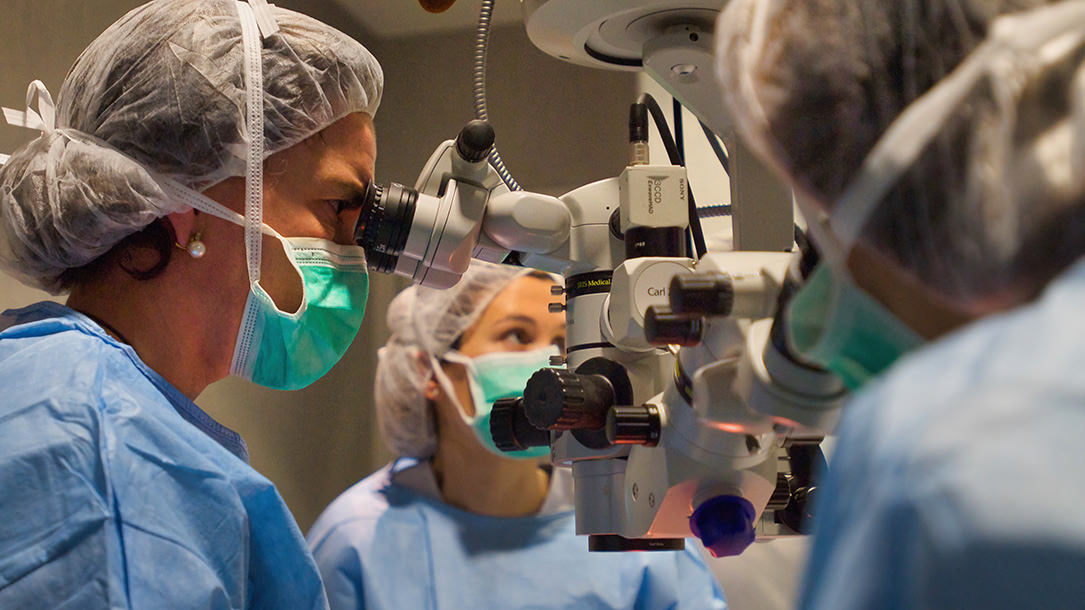
When is glaucoma surgery indicated?
Glaucoma surgery is not the first line of treatment. The vast majority of patients are adequately managed with hypotensive eye drops and, in many cases, with laser treatment (SLT). Surgery comes into play when these options fail to control intraocular pressure to the level required to halt damage to the optic nerve.
These are the most common situations in which we consider surgery:
- IOP not controlled with maximum tolerated medication and/or laser.
- Progression of optic nerve damage or visual field loss despite medical treatment.
- Intolerance to eye drops (allergy, chronic irritation, ocular surface toxicity).
- Advanced glaucoma cases that already present a critical situation and require stricter IOP control from the outset.
- Non-compliance with medical treatment when the disease has become a risk to vision.
In all cases, the decision is individualised and made together with the patient, taking into account age, the type of glaucoma, the state of vision and the anatomical characteristics of each eye.
Why patients choose us for glaucoma surgery
Glaucoma surgery is one of the ophthalmic procedures where the surgeon's experience matters most. It is not a standardisable procedure like cataract surgery: every eye heals differently, every glaucoma has its own history, and the choice of technique and its execution make the difference between preserving vision or not.
At VERTE we have been a reference centre in glaucoma surgery for over 35 years. These are the pillars of our authority in this field:
- The team that introduced drainage implants in Spain in 1990 — We were national pioneers in one of the most complex techniques and, still today, the reference solution for the most severe glaucomas.
- Over 20 years training glaucoma surgeons — A significant number of professionals currently working at other national and international centres received their surgical training at VERTE under the direction of Dr Susana Duch.
- International surgical training — The director of the unit, Dr Duch, completed her postgraduate glaucoma training at the University of California San Francisco (UCSF) in 1990 and 1993, one of the world's leading centres for this condition.
- Founders of EMMEIG — VERTE is the driving team behind the most important Multicentre Genetic Study of Glaucoma in Spain, which is helping to better understand the hereditary components of the disease.
The aim of surgery: achieving stable IOP control
Glaucoma surgery does not cure the disease: it controls it. Glaucoma is a neuropathy of the optic nerve that, once diagnosed, requires lifelong management. What surgery achieves is lowering intraocular pressure and stabilising it throughout the 24 hours of the day, preventing the fluctuations that progressively damage the optic nerve fibres.
Most surgical techniques achieve this objective by creating a new outflow pathway for the aqueous humour — the fluid inside the eye whose accumulation causes the increase in pressure. This is why many of the techniques we perform are grouped under the term filtering surgery: they help to "filter" the aqueous humour towards the exterior, regulating the pressure.
The results of any glaucoma surgery depend on three factors:
- The technique chosen and its suitability for the type and stage of glaucoma.
- The anatomical state of the eye (previous surgeries, conjunctival characteristics, corneal thickness).
- The surgeon's experience, which in glaucoma is absolutely decisive.
Surgical techniques we perform
We have had the opportunity to develop an in-depth knowledge of all glaucoma surgical techniques, listed here from least to most surgically invasive. The choice depends on the type of glaucoma, the stage of the disease and the characteristics of each patient.
Minimally invasive glaucoma surgery (MIGS)
MIGS (Minimally Invasive Glaucoma Surgery) are techniques that use micro-implants of less than 1 millimetre to improve aqueous humour drainage. They are faster procedures, with a simpler postoperative course and a very high safety profile. They are indicated in mild or moderate glaucoma, frequently combined with cataract surgery.
At VERTE we perform the main MIGS available on the market: iStent, Hydrus and XEN. The first iStent implanted in Spain was performed at our centre (documented in Buchacra et al., 2011).
Trabeculectomy with Mitomycin-C
Trabeculectomy is the classic filtering surgery and the most historically used technique for glaucoma. It creates a new drainage pathway for the aqueous humour through a small opening in the sclera, protected by a subconjunctival "bleb". It is complemented with Mitomycin-C (MMC), an anti-scarring agent that prevents fistula closure and improves long-term outcomes.
It is an effective technique but requires a more careful postoperative course. In expert hands, it remains the reference procedure for moderate-to-advanced glaucoma.
NPDS (Non-Penetrating Deep Sclerectomy) with MMC
A surgical variant that creates a drainage pathway without fully perforating the globe, reducing the risks of postoperative hypotony. Its use is often combined with Mitomycin-C.
Viscocanalostomy
A "bleb-free" filtering technique that dilates Schlemm's canal using a viscoelastic substance, improving physiological drainage without creating an external drainage pathway.
Valved drainage implants (Ahmed)
Drainage implants are silicone devices that direct the aqueous humour from the anterior chamber of the eye towards a reservoir in an extraocular zone, beneath the conjunctiva. Valved implants (such as the Ahmed) incorporate a flow-regulation mechanism that limits the risk of immediate postoperative hypotony.
Non-valved drainage implants (Baerveldt, Paul, Molteno)
Non-valved implants (Baerveldt, Paul, Molteno) have no internal regulatory mechanism: they require stricter postoperative monitoring but offer very stable long-term outcomes. They are the reference solution for the most severe or refractory glaucomas.
VERTE was the team that introduced drainage implants in Spain. More than three decades later, we remain a reference centre for their implantation, with our own scientific publications comparing the outcomes of different models (Oliver-Gutiérrez et al., 2025: comparative study of Paul vs Baerveldt).
Piggy-back technique: two implants without opening the eye
The Piggy-back technique is one of the most specialised solutions we apply at VERTE. It consists of implanting a second drainage device without the need to reopen the eye, using minimal surgical access. It is indicated in patients with a previous implant whose drainage capacity has been compromised and who need to reinforce IOP control.
It is a technique that requires very specific surgical expertise and forms part of our differential procedures.
Diode laser cyclophotocoagulation
For advanced cases in which previous surgeries have failed, we resort to cyclophotocoagulation: a laser technique that reduces aqueous humour production by acting on the ciliary body. It is performed in the operating theatre under deep anaesthesia.
How we choose the right technique for each patient
There is no single "best glaucoma surgery". There is a best surgery for each patient. For this, the experience of the glaucoma specialist ophthalmologists and the relationship of trust between doctor and patient are fundamental. The choice of technique depends on:
- The stage of glaucoma (mild, moderate, advanced, refractory).
- The type of glaucoma (primary open-angle, secondary, neovascular, post-traumatic).
- The target IOP we need to achieve. The lower the safe IOP we must reach, the more complex the technique may be.
- The state of the conjunctiva (previous surgeries, scarring, toxicity from years of eye drop treatments).
- Whether concomitant cataract surgery exists (in which case we consider combining with MIGS).
- The individual characteristics of the patient (age or other concurrent ocular or systemic conditions, ability to attend follow-up appointments, distance from home, cases of dependency...).
As noted in our own scientific publication (Duch S., Surgical treatment of glaucoma: past, present and future, Annals d'Oftalmologia, 2024): "technique selection must be personalised according to the stage of glaucoma and the specific needs of the patient, supported by evidence and cost-effectiveness analysis".
At VERTE, no patient receives a decision based on a single criterion: complex cases are discussed at the weekly clinical session by the entire surgical team. This guarantees that the surgical indication is collectively validated before being proposed to the patient. What a team analyses and decides far exceeds individual medical judgement.
The surgical team
Glaucoma surgery at VERTE is performed by a team of 8 glaucoma specialists dedicated exclusively to this condition, with experience in advanced surgery.
Dr Susana Duch — Director of the Glaucoma Unit

Over 35 years of experience with a special dedication to advanced glaucoma surgery. Postgraduate training at UCSF (1990, 1993). Doctor of Medicine, University of Barcelona. Associate Professor of Ophthalmology (UB) for several years. Senior Consultant at the Glaucoma Unit of Hospital de Bellvitge between 1988 and 2004. Member of SEG, EGS, SEO, SCO and AAO. Author of the chapter Surgical treatment of glaucoma: past, present and future (Annals d'Oftalmologia, 2024). A career that places her among the most influential glaucoma surgeons in Spain.
Dr Elena Millà — Specialist in Surgical Glaucoma

Dr Carlos Arciniegas — Glaucoma Specialist
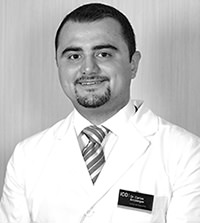
Specific dedication to microincisional surgery and drainage implants. European Fellowship in Ophthalmology (FEBO), Master's in Anterior Segment from the Institut Barraquer and Master's in Molecular Ophthalmobiology from the University of Valencia. Surgical trainer and EU consultant for the XEN implant (one of the most advanced glaucoma drainage devices available) between 2014 and 2015. Speaker at leading international congresses including ASCRS and EGS.
The team is completed by Dr Elena Ávila, Dr Naiara Relaño, Dr Shirin Djavanmardi, Dr Núria Gabarró and Dr Gloria Segura.
VERTE is a surgical training centre: surgeons who today work at national and international reference centres have trained at our facilities under the direction of Dr Duch. This is one of the clearest signs of our team's clinical authority.
Our surgical research
Our team does not merely apply science: it produces it. These are some of our scientific publications focused on glaucoma surgery:
- Oliver-Gutiérrez et al. (2025) — Comparative study of Paul and Baerveldt drainage implants in complex glaucomas. Study conducted with VERTE patients.
- Duch S. (2024) — Surgical treatment of glaucoma: past, present and future. Chapter published in Annals d'Oftalmologia (Vol. 32, No. 4). Comprehensive review of modern glaucoma surgery.
- Duch S. (2022) — Presentation "Tubes: State of the art" at the 15th Congress of the European Glaucoma Society (EGS 2022, Athens) and direction of the Training Course on Glaucoma Drainage Implants.
- Duch et al. (2021) — Drainage implants in refractory glaucomas.
- Buchacra et al. (2011) — Documentation of the first iStent implanted in Spain, at VERTE.
This sustained scientific output places us among the centres with the greatest authority in glaucoma surgery in southern Europe.
Our own operating theatres: planned and emergency surgery
Controlling the entire diagnostic and therapeutic process is of great importance. This aligns all variables and ensures all procedures are managed to the benefit of outcomes and the best patient experience. Having our own operating theatres since 2003 allows us to work in two modes:
- Planned surgery — With a weekly surgical schedule, detailed preoperative planning and structured postoperative follow-up.
- Emergency surgery — In cases requiring immediate intervention: complications from previous surgeries (excessive filtration, severe hypotony, infection), acute IOP decompensation not manageable with medical treatment, or emergencies referred from other centres and ophthalmologists.
For non-surgical ophthalmic emergencies related to acute glaucoma (acute angle-closure attack with intense pain, red eye, blurred vision and nausea), our 24-hour Ophthalmic Emergency Service operates 365 days a year.
The process: from assessment to surgery
- Initial surgical assessment — A specialist consultation in which we review your medical history, previous tests and perform the necessary diagnostic studies (OCT, visual field testing, biomechanical pachymetry, gonioscopy).
- Shared decision-making — We explain the technical options appropriate to your case, their real advantages and limitations, and we decide together. Complex cases go through a team clinical session before being proposed.
- Surgical scheduling — Assignment of a surgical date and specific preoperative instructions.
- Day of surgery — Procedure carried out at our facilities by one of the unit's surgeons.
- Postoperative follow-up — Scheduled reviews at 24 hours, one week, one month and progressively throughout the first year. Telephone consultations available between appointments to resolve queries without the need to travel. In complex cases, if necessary, we see the patient daily until we achieve safe levels to space out the monitoring.
Some aspects of the process (cost, insurance cover, type of anaesthesia, hospital admission, sick leave) are specific to each case and are explained during the initial assessment.
Risks and postoperative period: we tell you the whole truth
Glaucoma surgery is effective but no technique offers 100% guaranteed success. We explain the real risks and what the postoperative period involves so that you can make an informed decision.
Risks specific to glaucoma surgery:
- Excessive aqueous humour filtration, which may cause postoperative hypotony.
- Development of a wound leak due to poor closure of the surgical wound.
- Abnormal redirection of aqueous humour towards the posterior segment of the globe.
- Delayed or late haemorrhage (which is why we always check clotting before operating).
- Fistula closure due to excessive scarring, a risk that persists even years after the procedure.
- Risks common to all ophthalmic surgery (infection, inflammation).
Why the postoperative period can be demanding:
The healing of the surgical wound and the filtering fistula differs from patient to patient. Some heal quickly (which can be a problem if the fistula closes too soon), others slowly. This is why postoperative monitoring is personalised and prolonged.
In many filtering techniques we use anti-scarring agents (Mitomycin-C, 5-Fluorouracil) to slow scarring and keep the fistula functional for as long as possible. Until one month after the procedure we cannot confirm that the surgery has been a success.
Important: the risk of fistula closure always exists, even years later. This is why the follow-up of a patient who has undergone glaucoma surgery is lifelong, with more spaced but permanent monitoring.
This is the truth about glaucoma surgery. We share it because we believe an informed patient makes better decisions and copes better with their postoperative period.
Comprehensive support throughout the process
Glaucoma surgery is not just a surgical procedure: it is a process that can generate anxiety, doubts and changes in daily life. This is why we offer:
- Psychological Counselling Service for Visual Loss — Led by Clara Duch. Emotional support for patients diagnosed with advanced glaucoma or with anxiety about surgery.
- Integrated Dry Eye Unit — Chronic use of eye drops prior to surgery and postoperative anti-inflammatory agents can affect the ocular surface. The Dry Eye Unit treats these effects to ensure a comfortable recovery.
- Telephone consultations — Resolve queries between appointments without travelling.
- Weekly clinical session — Your case, if complex, is discussed as a team. It is not an individual decision made by the surgeon alone.
Coming from another centre? Surgical second opinion
If you already have a glaucoma diagnosis from another centre and are considering surgical options, we offer second opinion consultations. During this assessment:
- We review your previous tests (OCT, visual field, treatments performed).
- If necessary, we complete the study using our own technology.
- We explain the options we consider appropriate and why.
- If your current surgical indication is correct, we will tell you honestly. If we believe better alternatives exist, we will say so too.
A second opinion is always a sensible decision before an irreversible procedure such as glaucoma surgery. In many cases, and if the patient wishes, we work in coordination with their own ophthalmologist. Combining expertise benefits outcomes, with the patient's wellbeing as our sole mission.
Request your second opinion consultation
Request your glaucoma surgical assessment at VERTE Barcelona
If you have been advised to undergo glaucoma surgery or if your glaucoma is progressing despite medical treatment, request a surgical assessment with our team. We will study your case and present the most appropriate technical options with honesty and expertise.