

Age-related macular degeneration: AMD
Age-related macular degeneration: AMD
What is Age-related Macular Degeneration (AMD)?
It is a degenerative eye disease that affects the central area of the retina (called the macula) in people over 50 years of age. The macula is responsible for central vision and fixation, and therefore for such common activities as reading, watching television or driving.
How common is AMD?
AMD is the leading cause of irreversible visual loss in the Western world in people over 50 years of age. In Spain, 13% of people over 65 suffer from this disease. Among those over 75, 30% are affected to some degree.
What symptoms does AMD cause?
Symptoms of macular involvement may include, in order of frequency:
- Blurred central vision, with peripheral vision preserved.
- Distortion in the shape of images (metamorphopsia).
- Distortion in the size of images: larger (macropsia) or smaller (micropsia).
What types of AMD are there?
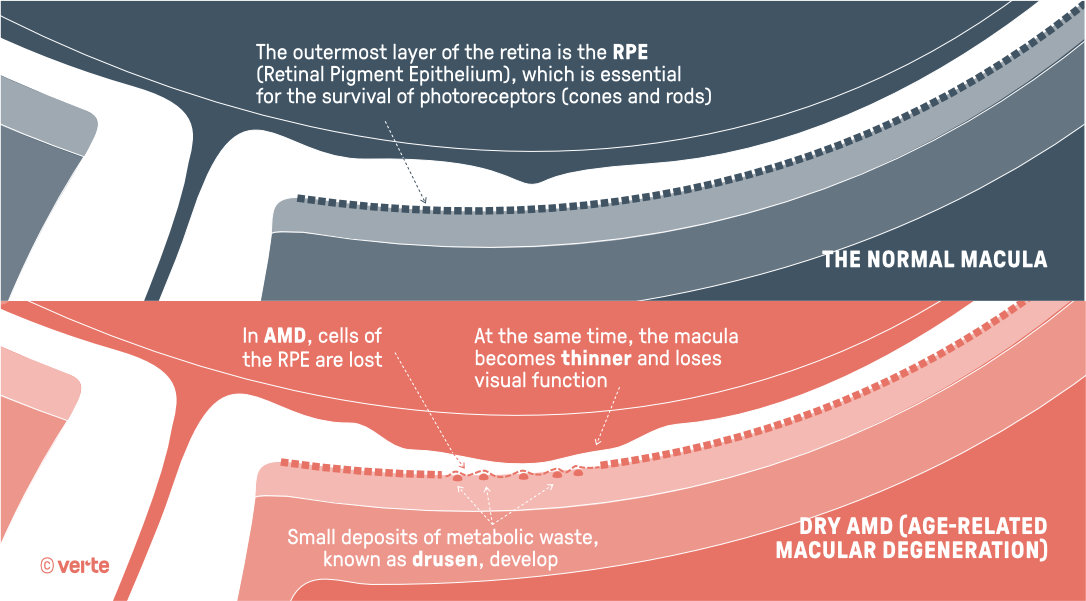
- Dry or atrophic AMD: this is the most common form of the disease (90% of cases). Disease progression is slow (years) and total vision loss can take decades. Initially it may produce no symptoms and is diagnosed through ophthalmic check-ups. There is a progressive loss of nerve cells in the macula.
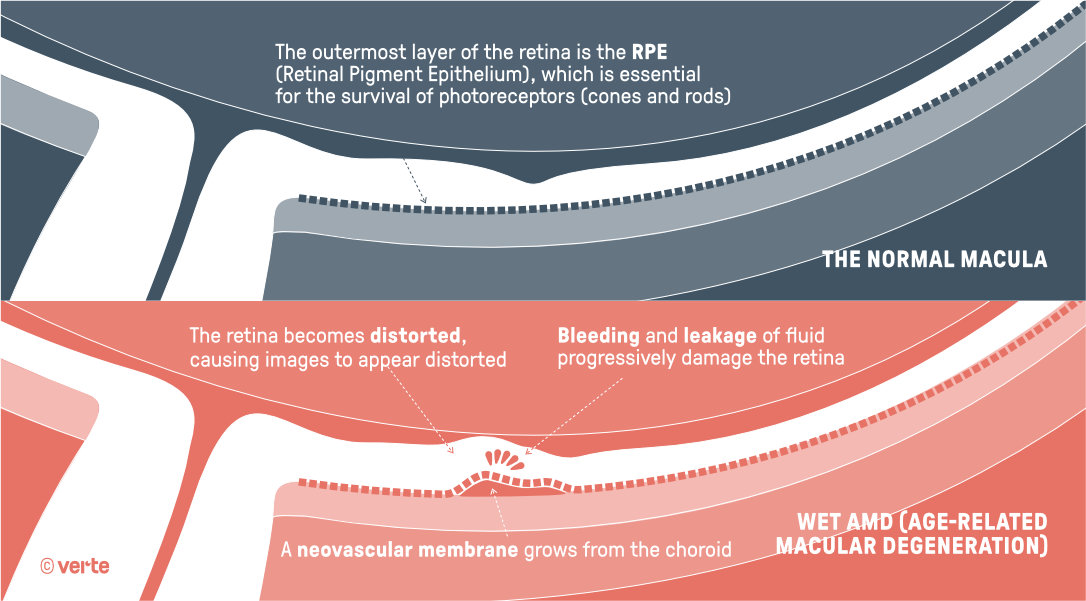
- Wet or exudative AMD: although it is the less common form (10% of cases), it is very aggressive and leads to loss of central vision in a short time (weeks, months). A new tissue grows beneath the deepest layers of the retina, which grows, exudes fluid and may bleed (neovascular membrane).
Patients with dry AMD may convert to the wet form and vice versa. Early diagnosis of both forms can improve disease progression.
How is AMD diagnosed?
Many patients do not become aware of their condition until their vision has become blurred or visual disturbances such as metamorphopsia appear. The ophthalmologist can detect the disease at earlier stages by performing a series of tests which, depending on the degree of involvement, normally include:
- Amsler grid test: the patient looks at a grid page to determine the degree of involvement or metamorphopsia. This test can be given to the patient to perform periodically at home to detect changes at an early stage.
- Fundus examination: a thorough examination of the macular area to assess the degree of involvement and determine whether it is the dry or wet form.
- Fluorescein angiography (FA), generally used in wet AMD, defines the location, extent and degree of activity of the neovascular membrane as it fills with contrast.
- Optical Coherence Tomography (OCT), which shows virtual microscopic cross-sections of the macula and provides a great deal of information to the ophthalmologist, in both the dry and wet forms of AMD. It is indispensable for evaluating the response to treatment in the wet form.
How is AMD treated?
In general, the management of AMD falls to ophthalmologists specialised in the retina (retinal specialists) or even specialists exclusively in the macula.
Dry AMD: unfortunately there is no specific treatment. Various vitamin supplements (antioxidants, lutein) are used which may slow disease progression in intermediate-to-advanced stages.
Wet AMD: in recent years, new medications with complex names (bevacizumab, ranibizumab, aflibercept…) have become available to halt disease progression. They are administered as periodic intraocular injections until the lesion becomes inactive.
This treatment has dramatically changed the prognosis of exudative AMD, as it makes it possible to halt vision loss and even improve it in some cases. Early diagnosis is essential, as treatment is more effective the smaller the lesion and the shorter the time of progression.
At VERTE, the members of the Retina Unit have extensive experience in the administration and evaluation of these drugs since the beginning of their clinical application in 2006.
Can we prevent AMD? Risk factors
The main risk factor is age, as the disease only affects people over 50 and the risk increases significantly from the age of 65. It is also more common in fair-skinned individuals and a genetic predisposition is known to exist. These risk factors are beyond our control and are therefore not modifiable. Other factors that we can control and that have been scientifically associated with AMD include:
- Smoking: this is the main avoidable risk factor. It considerably increases the risk of developing AMD.
- Obesity / High-fat diet: this can accelerate the process of macular degeneration and therefore of loss of visual acuity.
- Arterial hypertension / Cardiovascular disease.
- Solar radiation.
Therefore, upon diagnosis of AMD it is essential to place yourself in the hands of your ophthalmologist for the management of the disease, but as with the prevention of many other conditions, it is also important to maintain a healthy lifestyle, with a varied diet and regular exercise.