

Presbyopia - Tired sight
The difficulty of seeing up close from the age of 45.
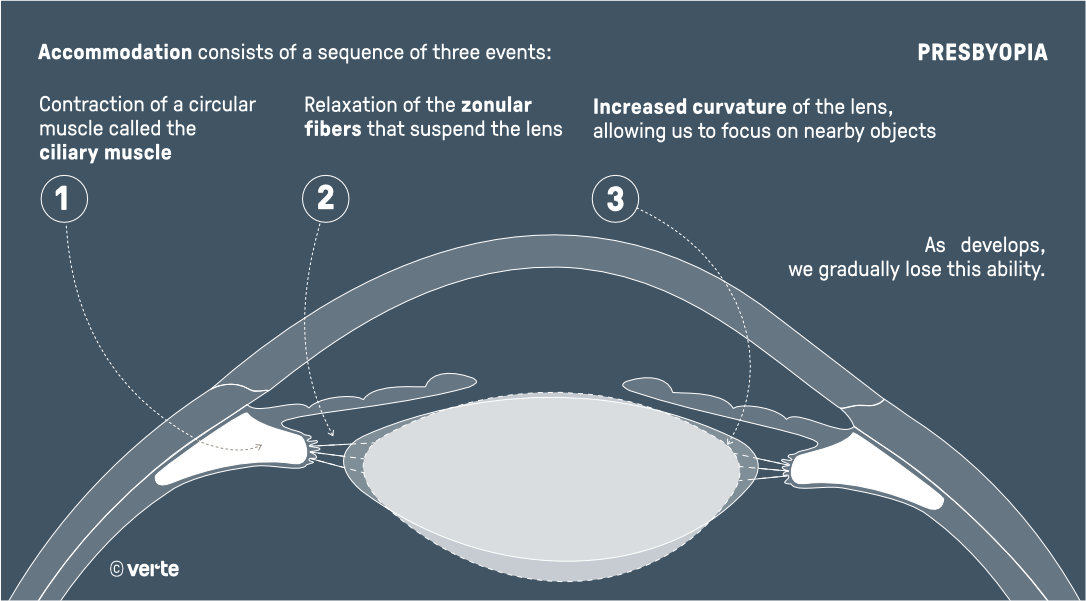
What is presbyopia?
As people get older, the crystalline lens gradually dehydrates, becomes more rigid and loses the ability to change its shape in order to focus on nearby objects. This is what is known as presbyopia or "tired sight". This phenomenon generally occurs from the age of 40-45 and is complete by around the age of 65, at which point near focus is no longer possible.
At what age can it be detected?
Around the age of 45, difficulty seeing up close begins to be noticed. For example, when reading, letters may appear blurred or even unstable. Letters will never become distorted. If this occurs, it is a different condition and an urgent visit to the ophthalmologist is necessary to rule out an alteration of the macula. Visual effort can cause ocular or head pain.
Presbyopia is corrected with...
Near vision glasses, as the classic treatment. From 0.5 to 3 dioptres, focus can be achieved up to the usual reading distance of 33 cm.
To avoid dependence on glasses, other optical systems have been developed. The safest are:
- Multifocal contact lenses
- Multifocal intraocular lenses, following cataract surgery.
Other techniques that have not yet reached sufficient levels of safety and stability include, among others:
- Accommodative intraocular lenses
- Intracorneal lens implantation
- Presbyopia laser treatment (presbyLASIK)
Is it associated with any disease?
No, presbyopia is always a natural (physiological) process. However, the symptoms, especially when they first begin to be noticed and their cause is unknown, can be confused with other visual problems. It is therefore very important to visit an ophthalmologist or optician whenever there are visual difficulties.