

Macular hole
The spontaneous loss of central retinal tissue that we can now treat successfully in the majority of cases.
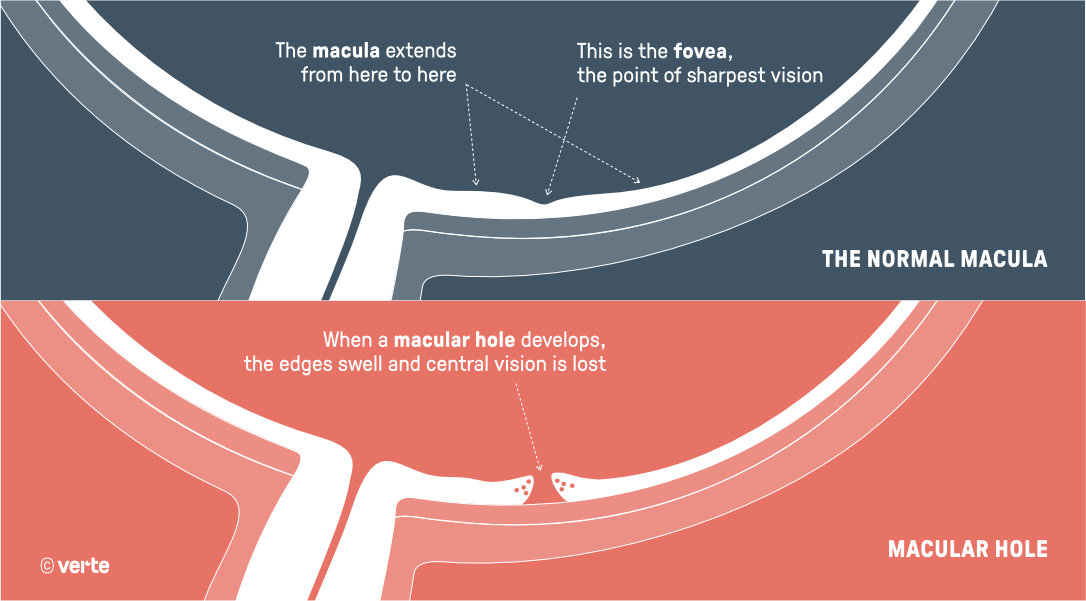
What is a macular hole?
A common or idiopathic macular hole is an eye condition that affects the macula. The macula is the central part of the retina, responsible for central vision (for example: reading or recognising a face).
Why does it occur?
With age, or in some cases due to trauma, the vitreous humour detaches from the macula. In some cases it fails to detach completely and stretches the macular tissue, forming a hole in the fovea (the central area of the macula).
Symptoms of a macular hole
Initially, symptoms may produce mild blurred vision or some distortion of the image. If it progresses, a "dark spot" may appear in the centre of the visual field that can, for example, make it impossible to read or see the time on a watch.
Can it be prevented?
Although it is not a condition we can prevent, it can be detected at early stages. Visual recovery is always better the earlier the hole is detected and therefore the sooner it can be closed.
Is it treatable?
Yes, it is treatable by surgery: vitrectomy. It currently has a good prognosis, as more than 90% of cases are successfully closed. In some early-stage cases it is possible to treat it even with an intravitreal injection of a drug called Ocriplasmin (Jetrea, Novartis), although spontaneous resolution can also occur.
How is it diagnosed?
A macular hole is diagnosed in the clinic by your ophthalmologist through a fundus examination (the pupils are dilated with drops and the retina is examined). Throughout the diagnostic process, tests may be requested to confirm the diagnosis (retinal photography and OCT). Performing an optical coherence tomography (OCT) is essential in this condition, as this test will confirm the diagnosis and provide details that cannot be seen directly by examining the fundus.
What does the treatment of a macular hole involve?
Once the definitive diagnosis has been established, surgery must be performed within a short period of time. The procedure is called Posterior Vitrectomy and consists of removing the vitreous humour and detaching it from the macula. In addition, it is usually necessary to remove a very thin membrane (ten times thinner than a hair) situated on top of the macula, called the Internal Limiting Membrane. At the end of surgery, a gas bubble must be introduced into the eye which, by being in contact with the hole, helps to close it.
Ocriplasmin (Jetrea, Novartis) achieves separation of the vitreous humour from the macula by chemical means. However, this treatment has some drawbacks: it is less effective than surgery and has a high economic cost.
What is the postoperative period like?
During the postoperative period the patient must maintain a face-down position for 4 to 8 days, so that the gas bubble is in contact with the macular hole, helping it to close. While the gas is present in the eye, flying is strictly prohibited, as the gas expands at altitude and could cause a dangerous rise in pressure.
Finally, at the end of the postoperative period, a further OCT is performed to confirm closure of the macular hole. From one month onwards, the patient can resume their normal daily life.
Are there any other types of macular hole?
Certain particular cases carry a higher risk of developing this condition: patients with myopia greater than 6 dioptres and those who have suffered trauma. Patients who develop a macular hole in one eye have a somewhat higher risk of developing it in the other eye (10–15% higher). These particular cases share the common feature that the prognosis is not as favourable as in a simple macular hole and the efficacy of surgery is lower.