

LASIK - Surgery
LASIK Surgery: The fastest and most effective technique in eye surgery.
LASIK Eye Surgery Barcelona
LASIK surgery is the most widely used vision correction procedure in Barcelona for eliminating dependence on glasses and contact lenses. At VERTE Ophthalmology, we have been performing this procedure for over 25 years with demonstrable results: our retreatment rate is 2–3%, significantly lower than the 10% that medical literature considers acceptable.
We use the Schwind AMARIS 750S laser, which operates at 750 Hz with 6D eye-tracking technology (1,050 measurements per second) and a 0.54 mm spot size that allows exceptional precision. The Refractive Surgery Unit at VERTE has over 25 years of specific experience in LASIK and more than 7,000 surgeries performed.
The price of LASIK surgery at VERTE starts from €1,100* per eye, including all follow-up appointments for 3 months, free retreatment within 6 months if required, and access to 24/7 emergency care at no additional cost. In cases of particular complexity, the final price may vary and is always confirmed before the procedure, with no surprises.
We also offer special prices for certain groups and agreements, such as holders of the Carnet Jove. Please enquire to find out whether this applies to you.
The first informational consultation is completely free of charge.
Important information: This information is for educational purposes only and does not replace a professional medical consultation. Each case requires a personalised assessment to determine the suitability of treatment.
AMARIS 750S Excimer Laser Technology: Verifiable Precision
At VERTE we work with the Schwind AMARIS 750S, a sixth-generation system with verifiable technical specifications:
- Repetition frequency: 750 Hz, allowing correction of one dioptre in approximately 1.5 seconds
- Spot size: 0.54 mm, the smallest available for maximum precision
- 6D eye-tracking: Ocular tracking system with 1,050 measurements per second that compensates for involuntary movements in six dimensions, which is of great importance in preventing treatment decentration
- Personalised ablation: Combines three technologies (Ocular Wavefront, topography-guided and Aberration-Free) to adapt the treatment to the unique optical and anatomical characteristics of each eye
The 6D eye-tracking system of the AMARIS 750S not only follows horizontal and vertical eye movements, but also compensates for cyclotorsional rotation (rotation of the eye on its axis), both static and dynamic. This is especially important in patients with astigmatism, where a deviation of just a few degrees can significantly affect the outcome.
2–3% Retreatment Rate: Demonstrable Results
Our retreatment rate of 2–3% is one of our most important differentiators. To put this figure into context: international medical literature considers a retreatment rate of 7% acceptable for LASIK surgery. This means that our results are 3 times better than the standard considered "good" by the scientific community.
Why do we achieve such a low retreatment rate?
- Rigorous candidate selection: We prioritise safety over volume. We only operate on corneas with adequate thickness, regular curvatures, robust biomechanical patterns and good tear quality.
- Expert refraction of each eye, in its natural state and after dilating the pupil and suppressing the focusing effect (accommodation).
- Precision measurement technologies using state-of-the-art instruments (Oculus Pentacam corneal tomographer, Oculus Corvis corneal biomechanics analyser, Sirius topographer, Yalkaid anterior segment optical coherence tomographer, Zeiss IolMaster biometer)
- Precision treatment technology: The AMARIS 750S with 6D eye-tracking minimises the margin of error
- Surgical team experience: Our Refractive Surgery Unit, led by Dr. David Andreu with 25 years of specific experience in LASIK and Dr. Núria Manrique, has performed more than 7,000 refractive surgeries with consistent results
- Strict protocols: We follow quality protocols established by Innova Ocular based on scientific evidence, with particular mention of the UNE 179003:2013 certification focused on patient safety.
In the exceptional case that a retreatment is necessary, this is completely free of charge during the first 6 months after surgery, provided it is medically safe to proceed.
Postoperative Protocol: Personalised Care
At VERTE we have developed a postoperative protocol with two distinctive elements:
Therapeutic contact lens during the first 24 hours
After LASIK surgery, we fit a special therapeutic contact lens that the patient wears during the first 24 hours. This protocol provides three important benefits:
- Minimises postoperative discomfort: The lens acts as a protective barrier that significantly reduces the tearing and stinging typical of the first few hours
- Improves safety: It protects the corneal flap from accidental pressure during the most delicate period
- Speeds up recovery: It facilitates epithelial regeneration and improves visual comfort from the very first moment
Personalised follow-up call
On the same day as surgery, in the afternoon, our specialist support staff make a telephone call to each patient to:
- Verify that recovery is progressing correctly
- Answer any questions that may arise outside consultation hours
- Detect early any signs that require attention
- Alleviate any patient concerns with professional guidance
What is LASIK surgery?
LASIK (Laser-Assisted In Situ Keratomileusis) is a surgical technique that corrects refractive errors such as myopia, hyperopia and astigmatism by reshaping the cornea with an excimer laser.
The procedure consists of two main steps:
- Creation of a thin corneal flap: A thin lamella of approximately 100–120 microns in thickness is created in the cornea, which is lifted to access the deeper layers of the corneal stroma
- Application of the excimer laser: The AMARIS laser reshapes the corneal curvature by removing tissue with ultra-precise accuracy according to the personalised treatment pattern for each eye.
Once the laser ablation is complete, the flap is repositioned in its original position, where it adheres naturally without the need for sutures. The modified cornea allows light rays to focus correctly on the retina, providing clear vision without the need for glasses or contact lenses.
Since 1990, when the first LASIK procedures were performed, this technique has become the most widely performed vision correction procedure in the world due to its precision, predictability, speed and minimally invasive nature.
There are alternatives that apply the same Excimer laser without creating a flap, known as PRK and transepithelial PRK. These offer advantages for certain patients, particularly those with low prescriptions, and we apply them selectively.
Steps of the LASIK procedure
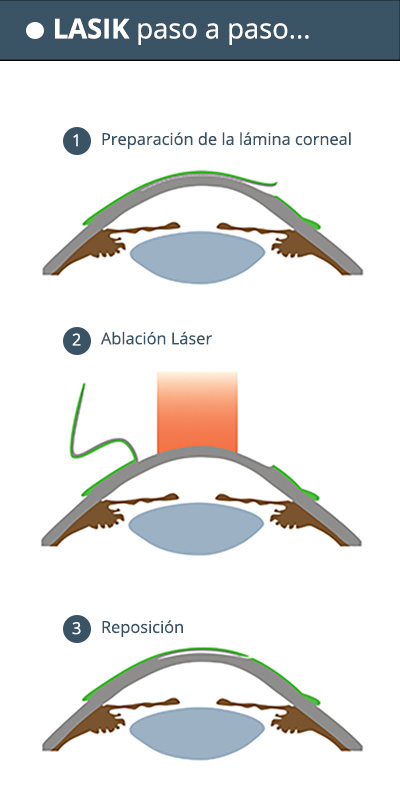
Step 1: Anaesthesia and preparation (30 seconds)
Topical anaesthetic drops are applied to the eye to eliminate any sensation. A delicate eyelid speculum is then placed to keep the eye open during the procedure. The patient feels no pain, only a slight pressure in some cases at the start of the procedure.
Step 2: Creation of the corneal flap (less than 7 seconds)
We use the Moria EVO 3E microkeratome to create the corneal flap. During these few seconds, the patient experiences a transient visual dimming and a sensation of gentle pressure. Once complete, the flap is carefully lifted.
Step 3: Application of the AMARIS laser (a few seconds per eye, proportional to the number of dioptres)
The patient must look steadily at a green light point whilst the AMARIS laser works. The 6D eye-tracking system follows any minimal movement of the eye to ensure that the ablation is performed exactly where it should be. During this phase, the patient feels absolutely nothing.
Step 4: Repositioning of the flap (30 seconds)
The flap is repositioned with microscopic precision. Thanks to the natural adhesion properties of corneal collagen, no sutures are required. The correct position is verified and the protective therapeutic lens is fitted.
The complete procedure takes approximately 10 minutes per eye. The time at the clinic, including preparation and a brief rest afterwards, is around one hour.
Step 5: Review before leaving the clinic
The final step is a slit-lamp examination to confirm that everything is in perfect order before you go home and rest with complete peace of mind. You will leave with your eyes open!
Main advantages of LASIK surgery
Fast
The procedure takes just a few minutes and uses state-of-the-art technology for maximum precision and safety.
Comfortable
Functional recovery occurs in approximately 24 hours. More than 80% of our patients achieve their maximum vision the day after surgery.
Glasses and contact lens free
The results are long-lasting and allow you to forget about optical correction in the vast majority of everyday activities. Some patients may occasionally need glasses for specific activities such as driving at night or reading small print.
Minimally invasive
By acting only on the corneal surface rather than inside the eye, LASIK has an excellent safety profile with very rapid recovery.
No hospital admission
The surgery is performed on an outpatient basis. The patient can go home with uncovered eyes immediately after the procedure.
Risks and possible side effects of LASIK surgery
LASIK surgery is a safe and well-established procedure with a high level of patient satisfaction. Nevertheless, like any surgical procedure, it may present some side effects or temporary discomfort. Most are mild and resolve over time.
At VERTE we carry out a thorough preoperative assessment to confirm that each patient is a good candidate, which significantly minimises the risk of complications.
However, before proceeding with surgery, you should be aware that the following may be experienced during the postoperative period:
- Dry eye: Experiencing dry eye after LASIK surgery is one of the most common side effects. It is usually temporary and improves with the use of artificial tears.
- Blurred or fluctuating vision: Some blurring after LASIK surgery is normal until the cornea completes its recovery process.
- Night-time haloes or light sensitivity: These may appear especially during the first few weeks, but tend to diminish progressively. With the latest generation lasers such as the AMARIS 750S, this problem has become very occasional.
- Mild discomfort or irritation: A sensation of grittiness or tearing during the first few hours, which disappears quickly with the prescribed medication, the protective therapeutic lens and, typically, a good rest.
- Epithelial ingrowth: This is a very infrequent complication in which surface cells advance beneath the flap. At VERTE we detect this during postoperative check-ups and, if necessary, it is corrected in a straightforward manner.
Important: No medical procedure is free of risks. During the preoperative consultation, our specialists will explain in detail all the risks and benefits specific to your particular case.
How do I know if I am suitable for LASIK surgery?
LASIK surgery requires meeting certain criteria that guarantee a safe and predictable outcome. At VERTE we confirm each of these through a complete preoperative assessment:
- Stable prescription: It is necessary for the myopia, hyperopia or astigmatism to have remained unchanged for at least one year. In young myopic patients we may recommend postponing the procedure if some progression of the myopic prescription can be anticipated. Visual lifestyle habits may be a factor in progression, particularly due to excessive use of screens and near vision.
- Cornea with adequate thickness and shape: Sufficient corneal thickness and regularity are essential for the treatment to be performed safely. We carry out high-precision topography and pachymetry to verify this.
- Minimum age: You must be at least 18 years old to be eligible for LASIK, although it is recommended to wait until the age of 21 when the prescription tends to be more stable.
- Not pregnant or breastfeeding: Hormonal changes can temporarily alter the prescription and affect the accuracy of measurements.
- Good tear quality: Moderate to advanced dry eye is a reason to avoid operating on the cornea and to consider alternative solutions such as ICL intraocular lens implantation.
- Absence of ocular disease: There must be no active pathologies in the eye such as keratoconus, cataracts, uncontrolled glaucoma, or surface and eyelid infections.
During the first free consultation*, we carry out an initial assessment to determine whether you are a candidate. If you decide to proceed, we schedule the complete preoperative tests, which include:
- Corneal topography and computerised tomography
- Pachymetry (measurement of corneal thickness)
- Ocular aberrometry
- Corneal biomechanics study
- Pupil dilation and fundus examination
- Dynamic pupillometry
- Tear quality assessment
- Binocularity study
The complete assessment takes approximately 60–90 minutes.
Is LASIK surgery not right for you? Available alternatives
If following the preoperative assessment we determine that LASIK is not the ideal option for your case, we offer equally effective alternative techniques:
PRK (Photorefractive Keratectomy)
Indicated for very low prescriptions or corneas with borderline thickness. No flap creation required.
TransPRK (Transepithelial PRK)
Our preferred technique when LASIK is not viable. It is a "no-touch" procedure that removes the epithelium with the laser itself.
ICL (Phakic Intraocular Lenses)
Ideal for high myopia, elevated hyperopia, dry eye or insufficient corneal pachymetry. A lens is implanted inside the eye without touching the cornea. Our team also has extensive experience with this type of lens, having implanted them over more than 20 years in a large number of patients.
VERTE Refractive Surgery Unit: Experience and continuity
Our Refractive Surgery Unit is led by Dr. David Andreu and Dr. Núria Manrique Donaire, both specialists in cornea and refractive surgery. This consolidated team guarantees consistent results and continuity of care for all our patients.
Dr. David Andreu – Director of the Refractive Surgery Unit
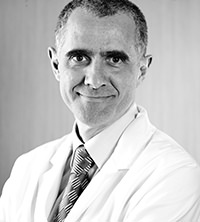
With 23 years of specific experience in LASIK and approximately 7,000 refractive surgeries performed, Dr. Andreu leads the Unit, contributing:
- Specialist training: Hospital Bellvitge and Hospital Germans Trias i Pujol (Barcelona)
- Academic experience: Former Associate Professor at the Autonomous University of Barcelona (UAB)
- Professional recognition: Member of SECOIR (Spanish Society of Implant-Refractive Ocular Surgery)
- Exclusive dedication: More than two decades focused on corneal refractive surgery
Dr. Núria Manrique Donaire – Refractive Surgeon
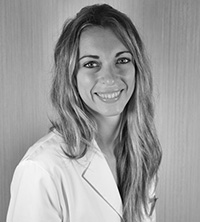
- Specialisation in cornea and refractive surgery
- Training in the most up-to-date LASIK and corneal refractive surgery protocols
- Commitment to surgical excellence and personalised care
Consolidated team and standardised protocols: Together they guarantee the same level of excellence in all LASIK procedures at VERTE. Standardised protocols and ongoing supervision ensure consistent results regardless of who performs the surgery, backed by decades of accumulated experience.
Clinical optometry team specialised in refractive surgery, led by D.O.O. Montserrat Ortiz
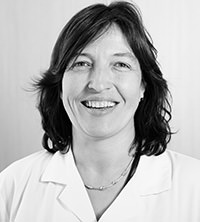
In the refraction of patients, the performance of diagnostic tests and the development of surgical plans, the contribution of the optometry team is fundamental. Led by D.O.O. Montserrat Ortiz, this team contributes significantly to the precision of results and the low retreatment rate at our clinic.
Price and financing of LASIK surgery in Barcelona
The cost of LASIK surgery at VERTE is €1,100* per eye, depending on the complexity of the case and the prescription to be corrected.
What is included in the price?
- The complete LASIK surgery with the AMARIS 750S laser
- All postoperative appointments for 3 months (as many as required)
- Free retreatment within the first 6 months if medically necessary
- Access to 24/7 emergency care at no additional cost during the 3-month postoperative period
- Protective therapeutic contact lens
- Personalised follow-up call on the day of surgery
What is NOT included in the price?
Postoperative eye drops have an approximate cost of €30–50 and are not included in the price of the surgery. The exact amount depends on the specific needs of each patient.
Financing options
- 0% interest financing for up to 10 months
- No deposit required
- Simple and quick application process
First consultation
- Initial informational consultation: FREE OF CHARGE * (Does not include prior preoperative assessment or tests.)
- Complete preoperative assessment with tests: Price available on request when booking an appointment
24/7 Ophthalmology Emergency Service in Barcelona
At VERTE we provide a 24-hour ophthalmology emergency service, 7 days a week, both in person and by telephone at our centre at Via Augusta 61, Barcelona.
Our emergency service includes:
- Immediate in-person care at Via Augusta 61
- Ophthalmic surgeon physically available in Barcelona
- Specialist telephone assistance 24/7
- No additional charge for LASIK postoperative emergencies during the first 3 months
This immediate availability is especially important during the postoperative period of any eye surgery, when the early detection and management of any complication is essential to ensure the best possible outcome.
ISO Quality Certifications
VERTE Ophthalmology holds 4 ISO certifications that guarantee the highest standards of quality, safety and management:
- ISO 7101:2013 – Quality management specific to ophthalmological services
- UNE 179003 – Risk management for patient safety
- ISO 9001 – Quality management systems
- ISO 14001 – Environmental management systems
These certifications are regularly audited by independent external bodies and guarantee that our protocols, procedures and standards of care comply with the most demanding regulations at national and international level.
VERTE Ophthalmology, part of Innova Ocular
VERTE is part of Innova Ocular, the leading network of centres of excellence in ocular wellbeing in Spain. This membership provides significant benefits for our patients:
Standardised quality protocols based on scientific evidence
- Possibility of a second medical opinion within the network
- Continuity of care if you relocate to another city where Innova Ocular has centres
- Access to shared state-of-the-art technology across centres
- Quality certifications integrated throughout the network
- Participation in shared trials of new technologies and intraocular lenses
This structure allows us to combine the personalised care of a local clinic with the support, resources and expertise of a national reference network.
* First consultation FREE OF CHARGE: does not include prior preoperative assessment or tests.
The price may vary depending on the complexity of the diagnosis.