

Uveitis
Inflammation of the interior of the eyeball. It is the condition that most requires collaboration with other medical specialists.
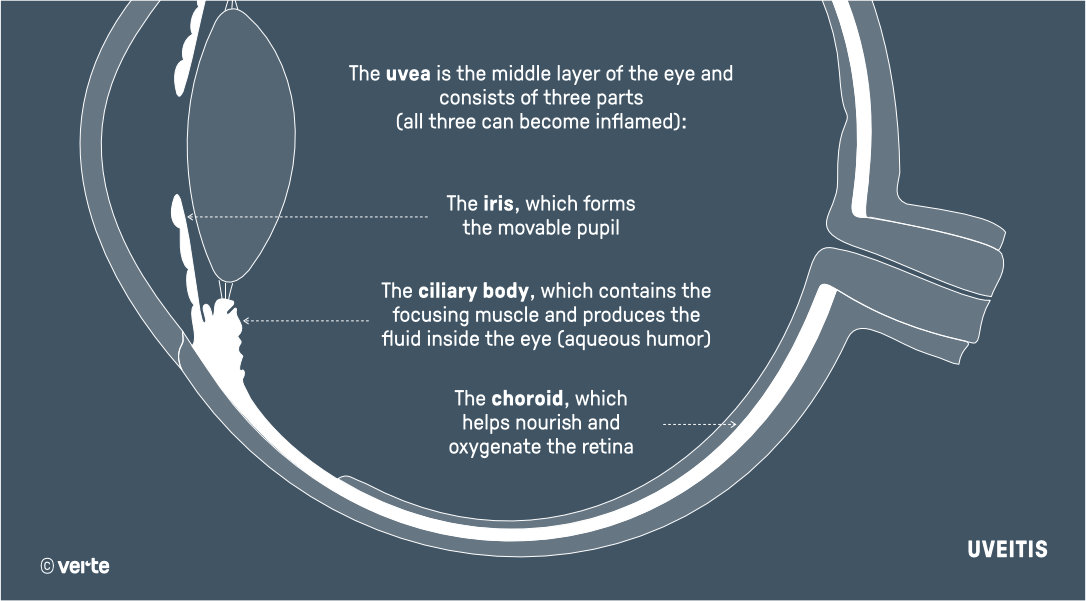
The term uveitis describes a process of intraocular inflammation. The uvea constitutes the middle layer of the three that make up the eyeball, situated between the sclera and the retina. It is composed of three parts: the choroid, the ciliary body and the iris.
It is not a specific disease but rather a manifestation of a wide variety of conditions.
Uveitis, or inflammation of the uvea, may be associated with another disease or occur as a result of an infection, although in many cases the cause is unknown. We explain the most relevant facts about this condition.
Why does uveitis occur?
In approximately 40% of patients with uveitis, an underlying disease can be identified, which is often of autoimmune origin. Conversely, many systemic diseases of rheumatological or infectious origin may present with uveitis among their clinical manifestations.
When does it manifest?
Uveitis tends to occur in middle age. Uveitis in the paediatric age group represents only 5-10% of all cases, and its diagnosis is also infrequent from the age of 60 onwards.
What symptoms does it produce?
It can affect one or both eyes. Symptoms can develop rapidly and may include: blurred vision, perception of floaters in the vision, eye pain, redness and sensitivity to light.
How is uveitis diagnosed?
A complete medical history and ocular examination must be performed. Depending on these, laboratory tests or the necessary diagnostic tests will be carried out to rule out infection or an autoimmune disorder. It is not uncommon for all studies performed to be normal.
Uveitis, although not very frequent, is an important cause of blindness worldwide.
Can it be prevented?
Treatment of an underlying disorder may help prevent uveitis in people with a general disease or infection.
When one or more episodes of uveitis have already occurred, a periodic visit to the ophthalmologist is recommended to determine whether the disease is advancing even if it is not clinically manifested.
Is there a treatment for uveitis?
The basis of treatment is topical (drops), local or systemic corticosteroids or immunosuppressants, depending on the type of uveitis. If a cause exists, such as an infection, the treatment will also address this.
Uveitis associated with systemic diseases (non-ocular diseases affecting more than one organ or system) has a multitude of causes; for this reason the approach in many cases must be multidisciplinary, and patients may sometimes need to be seen by different specialists (rheumatologist, internal medicine specialist, neurologist).